Precision Metal Welding for Commercial Kitchens and Hospitality
Precision metal welding is welding held to a specification: joints that fit before the arc is struck, heat that is controlled so the part stays flat and square, and finished welds that can be inspected against a stated standard. For a restaurant, hotel or institutional kitchen, it is the difference between a stainless countertop that stays level for years and one that rocks, cracks at a seam or traps grime. At Day Metal, welding is part of a Brooksville, Florida shop that also runs CNC machining, laser, plasma and waterjet cutting, so the parts arrive at the weld station already cut to tolerance.
TL;DR
- Precision welding is defined by fit-up, heat control and a written acceptance standard, not by how neat a bead looks.
- TIG suits thin stainless and visible, clean joints. MIG and MAG suit longer runs and thicker sections.
- Tolerances come from the code, your specification and the weld procedure, so state them in your request.
- Good cutting upstream makes good welding downstream: edge quality and part accuracy decide how well pieces fit.
- Send drawings, material grade, thickness, finish and the applicable standard to get an accurate quote.
Table of Contents
- What precision metal welding actually means
- Which welding process fits which job
- How a shop controls fit and distortion
- Tolerances: who sets them
- How weld quality is inspected
- What precision welding produces for hospitality
- What to send when you request a quote
- What drives cost, lead time and durability
- Bring your drawings to Day Metal
- FAQ
- Sources
What precision metal welding actually means
General welding joins metal so it holds. Precision welding joins metal so that the finished assembly meets dimensions, flatness, appearance and cleanliness requirements as well. The two overlap, but the second asks more of everything around the weld: layout, cutting, clamping, sequence and inspection.
It also differs from fabrication. Fabrication is the whole path from flat sheet or tube to a finished product: cutting, bending, welding, finishing and assembly. Welding is one step inside it. If you want the wider picture, our page on metal fabrication and welding in Brooksville shows how the steps connect.
For your project the practical meaning is this. A prep table, a sink with welded-in bowls, a wall panel with long visible seams or an exhaust hood with welded joints all need accuracy at the weld. A hood must close up square with its neighbors. A sink must drain to its outlet. A cladding panel must line up with the next one. The weld is where those requirements are won or lost.
Which welding process fits which job
The main manual arc processes each have a natural territory. A professional welding-society overview lists them like this:
| Process | Typical metals | Typical thickness | Where it is used |
|---|---|---|---|
| TIG (tungsten inert gas) | Mild and alloyed steels, aluminum, copper, titanium, nickel | 0.5 mm to 5 mm | Precision mechanics, apparatus and boiler construction, food-sector installations |
| MIG (metal inert gas) | Aluminum and other non-ferrous metals | 0.6 mm to 100 mm | Longer runs, thicker parts |
| MAG (metal active gas) | Mild and alloyed steels | 0.6 mm to 100 mm | Longer runs, thicker parts |
| Stick (manual metal arc) | Mild and alloyed steels | From 3 mm | Heavy sections, including building-site conditions |
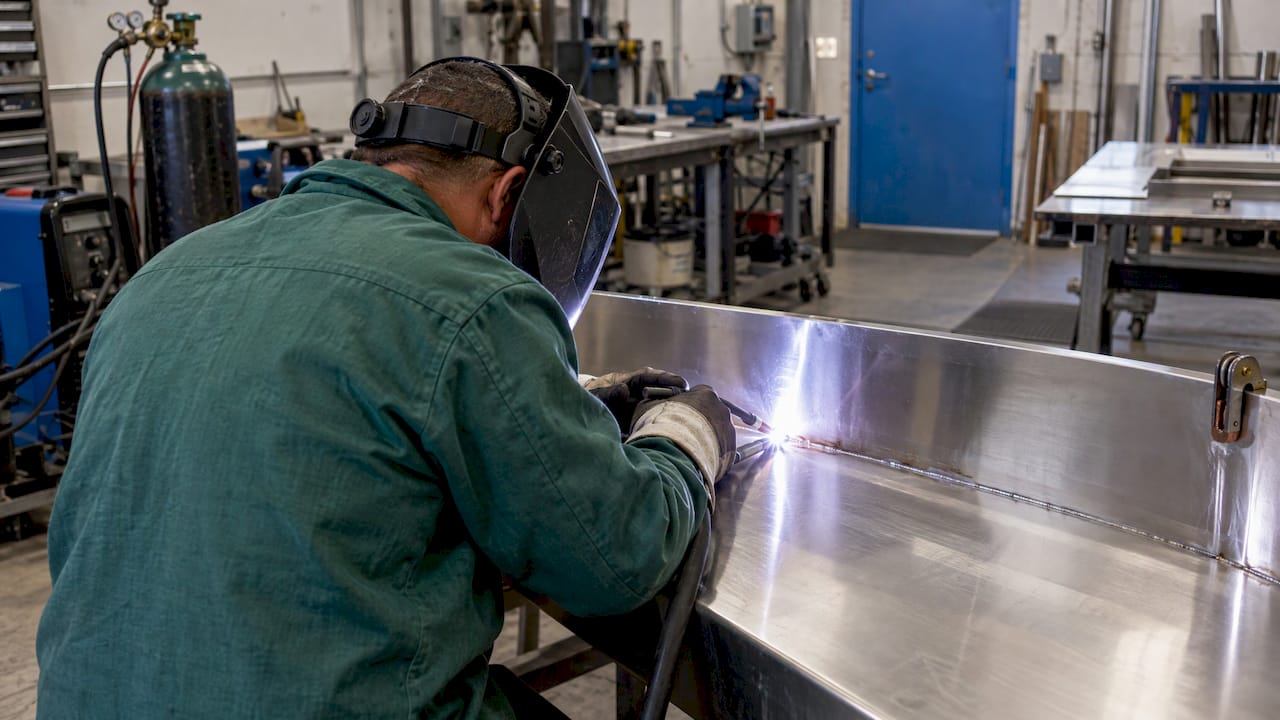
For kitchen and hospitality work, the thin-gauge range is the one that matters most. Countertops, sink bowls, table tops and cladding are usually sheet stainless, where the 0.5 to 5 mm window of TIG is exactly the territory in question, and where the weld stays visible and has to look and clean like the rest of the surface.
Heavier items, such as the frames under a table or the structure of a heavy enclosure, use thicker material where the faster processes make sense. The skill is in matching process to joint rather than defaulting to one method for everything.
For sheet work in particular, the American Welding Society publishes a dedicated standard. AWS D9.1/D9.1M:2026, the Sheet Metal Welding Code, covers arc and braze welding of nonstructural sheet metal up to 3 gauge (0.250 in or 6.4 mm), and names food processing equipment and architectural sheet metal among its applications. Its eighth edition was approved by ANSI on December 2, 2025.
How a shop controls fit and distortion
Heat is the enemy of flatness. Welding shrinks metal as it cools, and a long seam on a thin sheet can pull a panel out of shape. Controlling that is most of what separates precision work from ordinary work.
Fit-up comes first
A weld cannot fix a bad joint. Parts must meet with consistent gaps and aligned edges before welding begins. Fit-up is checked with tools such as tapes, micrometers, gauges and templates, according to a course lesson on tolerances and fit checking. Gaps that vary along a seam force the welder to add heat and filler unevenly, and that is where distortion starts.
This is why cutting quality matters so much. A part cut with a clean, accurate edge fits its neighbor without grinding or forcing. Our guides on laser cutting stainless steel and waterjet cut stainless steel explain how edge quality and thickness affect the parts that reach the welder.
Managing the heat
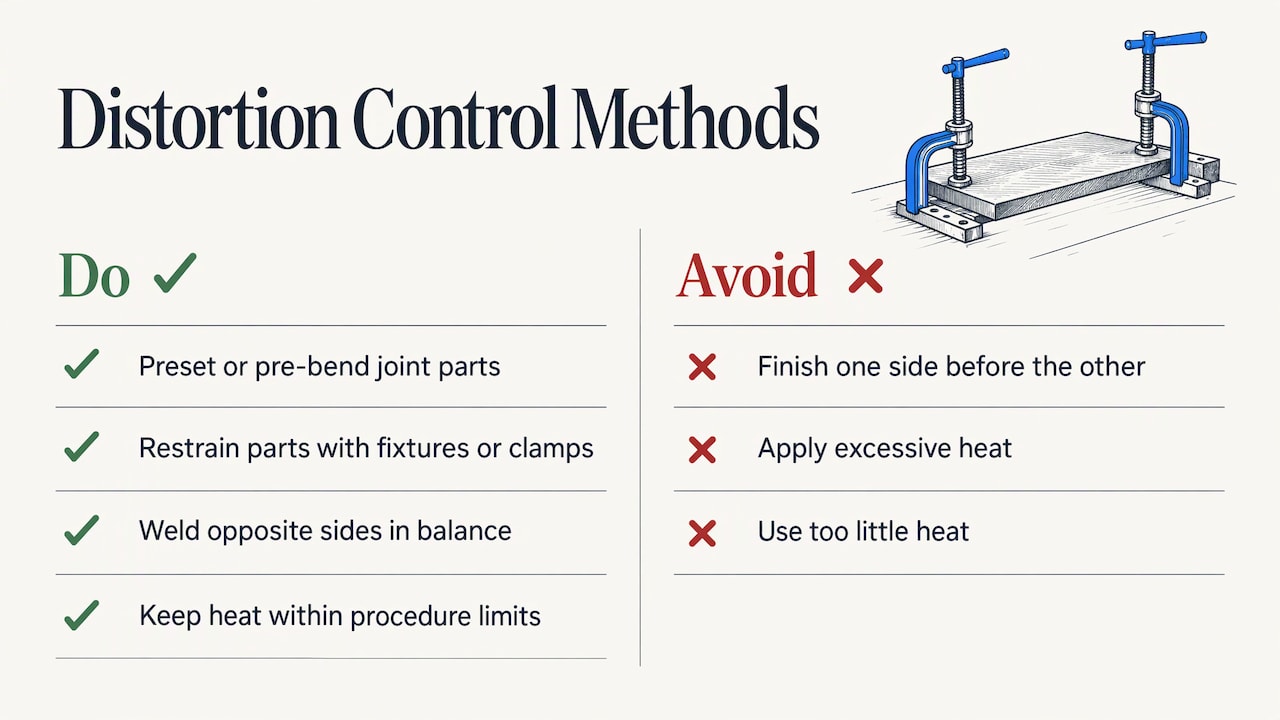
TWI, a welding research body, describes the standard approaches: pre-setting parts, pre-bending joint edges, or restraining them during welding with jigs, fixtures, flexible clamps and strongbacks. A balanced welding sequence, working on opposite sides rather than finishing one side first, also helps.
The same lesson adds that heat input should stay within what the weld procedure requires. Too much heat warps the part and can change the metal’s properties. Too little can leave a poor joint.
The lesson also gives a rule of thumb for planning: the transverse shrinkage of a butt weld can be estimated as about 0.2 × (weld area ÷ plate thickness) + 0.05 × root opening. You will not need to calculate it yourself, but it shows why shops allow for shrinkage in the layout rather than hoping for the best.
Tolerances: who sets them
A frequent misunderstanding is that “precision” is a single number. It is not. Tolerances come from the applicable code, the purchaser’s specification and the weld procedure. A pressure vessel built to ASME Section VIII Division 1, for instance, has its own limit: UG-80 caps out-of-roundness at 1% of nominal diameter, per the same tolerance lesson. Structural steel codes set their own limits on gaps, alignment and straightness.
For most kitchen and hotel work, no code dictates the dimensions of a countertop. You do, through your drawings. That is an advantage: you can specify what matters to you, such as flatness across a work surface, a consistent reveal between cladding panels or a sink that sits flush with a counter.
The tighter you go, the more machining, fixturing and inspection time the part needs. Specify tight tolerances where function demands them and looser ones elsewhere. Our guides on CNC machining tolerances and laser cutting tolerances show how to decide which dimensions deserve the tightest numbers.
How weld quality is inspected
Inspection starts with the simplest check: looking at the weld. Visual examination against an acceptance standard catches undercut, porosity at the surface, uneven bead width and misalignment. Dimensional checks confirm the finished assembly against the drawing.
Which standard applies depends on the work. For nonstructural sheet metal such as food equipment and architectural panels, the AWS D9.1 code above is the relevant reference in the United States. Where a project specifies a different code, the project specification governs.
The key point for a buyer is to name the standard, or the acceptance criteria, in the request. A weld that is “good” to one inspector may not meet another’s definition. Writing down the standard removes the argument before it starts.
What precision welding produces for hospitality
The commercial fixtures where precise welding shows up most are the ones your staff and guests touch every day:
- Countertops and work tables: welded seams, rolled edges and integrated backsplashes that have to stay flat and clean.
- Sinks: welded bowls, drainboards and splash guards that must drain correctly.
- Exhaust hoods: large welded enclosures where joints must be tight and square.
- Wall cladding: panels whose seams are visible across a whole wall.
- Heavy metal enclosures: structural boxes and housings where strength and alignment both count.
These are all product lines Day Metal manufactures locally in Brooksville. For a detailed look at the sheet-metal side, read our article on sheet metal welding services for commercial kitchens.
What to send when you request a quote
An accurate quote depends on a complete request. Gather these before you reach out:
- Drawings or sketches with dimensions. Architects and contractors can send CAD files or plan sheets; an owner can send a hand sketch with measurements and photos of the space.
- Material and grade. Stainless steel, aluminum or mild steel, and the gauge or thickness.
- Finish. Brushed, polished or as-welded, and which surfaces will be seen.
- Tolerances and standard. Flatness, fit to adjacent equipment, and any code or project specification that applies.
- Quantity and schedule. One counter or fifty, and when the site needs them.
- Install conditions. Access, wall condition, utility locations and who handles the install.
The sequence then runs from design review, to cutting, to forming, to welding, to finishing and assembly. Each handoff is a place where accuracy can slip, which is the reason to keep as many steps as possible under one roof.
What drives cost, lead time and durability
We do not publish prices, because each project is custom. These are the variables that move a quote, and you control several of them:
- Material and thickness. Heavier gauge and higher grades cost more to buy and take longer to weld.
- Joint length and complexity. More seam length means more welding time and more finishing.
- Finish requirements. Visible seams that must disappear into a brushed or polished surface take more labor than hidden structural welds.
- Tolerance level. Tighter numbers mean more fixturing and inspection.
- Quantity. Repeat parts allow jigs and programs to be reused.
- Scope. Cutting, bending, welding and assembly done by one shop remove handoffs and schedule gaps.
Durability follows from the same choices: the right process for the thickness, controlled heat, accurate fit and a finish suited to a wet, hot, cleaned-daily environment.
Perspective
A weld is only as accurate as the parts that reach it. That is why we think about welding as the last step of a chain, not a separate trade. Our shop in Brooksville, Florida, brings together CNC machining, fiber laser, plasma and waterjet cutting, and metal welding, so the person welding your countertop or hood is working with parts cut and prepared in the same building.
With over 60 years of combined experience on our team, we have a simple view of what commercial clients need: fixtures that fit the first time, seams that stay clean and surfaces that last under daily use. Our approach is to engineer each project around the client’s own requirements, then manufacture it locally with precision and durability as the goals.
If you are an owner, manager, contractor or architect weighing who should build your metalwork, ask for one team that handles cutting, welding and assembly together. It keeps accountability in one place and keeps tolerances intact from the first cut to the final installation.
the author
Bring your drawings to Day Metal
Day Metal offers metal welding as one of its services, alongside CNC machining, custom fabrication, premium assembly and cutting, for restaurants, hotels, healthcare, education and other commercial settings. Everything is manufactured locally in Florida. Send your drawings, material and tolerance requirements through our services page and tell us what the piece must do.

If you are still defining the project, the Day Metal homepage lists everything we build, from custom countertops and sinks to exhaust hoods, wall cladding, tables and heavy enclosures.
FAQ
Is precision welding the same as precision fabrication?
No. Welding is one step inside fabrication. Fabrication covers cutting, forming, welding, finishing and assembly, and a precise result depends on all of them working together.
Which process is best for stainless steel kitchen fixtures?
TIG is the process listed for thin metals from 0.5 mm to 5 mm, including food-sector installations, which covers most sheet stainless used in countertops, sinks and cladding. Heavier frames and structures may use MIG or MAG, which handle thicker sections.
What tolerance should I specify?
Specify what the function needs: flatness for a work surface, consistent gaps for cladding, a flush fit for a sink. Tolerances come from the code, your specification and the weld procedure, so put them in writing with your drawings.
What standard applies to welded sheet metal?
For nonstructural sheet metal in the United States, including food processing equipment and architectural sheet metal, AWS D9.1/D9.1M is the Sheet Metal Welding Code. If your project names a different standard, that one governs.
What should I send for a quote?
Send dimensioned drawings, material and thickness, finish, tolerances, quantity, schedule and installation conditions. The more complete the request, the more accurate the quote and the schedule.
Sources
- Manual welding processes, professional welding society poster
- Tolerances, distortion allowance and checking a fit
- Pre-setting, pre-bending or restraint distortion prevention, TWI
- AWS D9.1/D9.1M:2026 Sheet Metal Welding Code